

The screenshot has become our era’s shorthand for proof.
A clipped rectangle of chat bubbles can end an argument, win a breakup, cost someone a job, or spur a school into disciplinary action before anyone has time to breathe. In newsrooms, courts, and family group chats, the logic is the same: If it’s in a screenshot, it happened.
Except it often didn’t.
Over the past few years, counterfeit chat evidence has moved from the internet’s prank corners into a busy marketplace of harassment, fraud, and coercion. The tools are cheaper. The distribution is instant. And the psychological lever is reliable: people fear public embarrassment more than they fear a scam.
This feature traces the threat landscape where fake chats are weaponized, from sextortion rings to romance fraud, and why verifying a “simple screenshot” is now a serious security problem, not a pedantic detail.
The new ease of “evidence”
Years ago, faking a conversation meant either editing pixels by hand or leaning on crude templates. Now it’s closer to filling in a form: pick a platform skin, type two names, write the dialogue, and export a clean image with timestamps, profile photos, and read receipts. One common generator even offers multiple platforms in a menu, the kind of variety that makes it usable for jokes and also for something much darker. A person can build a plausible-looking conversation in minutes with a tool marketed for mockups like a fake whatsapp chat, then drop it into a group thread with a single line: “Explain this.”
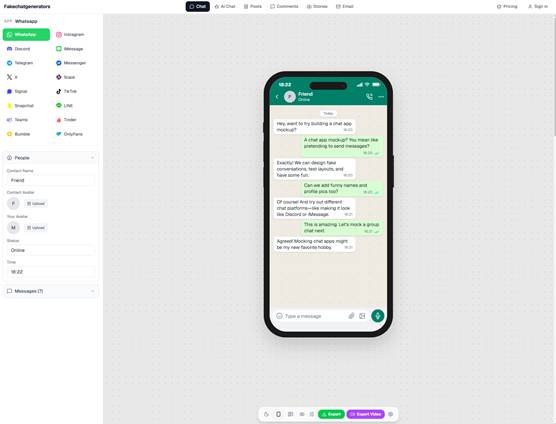
fakechatgenerators.com lets you mock up chat screenshots across 16 platforms
That speed is part of the danger. Fraud thrives when the victim has no time to consult anyone, no time to cool off, no time to remember that extraordinary claims require extraordinary proof. A screenshot feels like proof because it carries design cues we’ve learned to trust: app branding, familiar bubble colors, message ticks. The UI does a lot of persuasion on its own.
And because the screenshot is an image, not a text log, it slips through the cracks of common verification habits. People are trained to spot suspicious links, not suspicious pixels.
How fake chats become weapons, not jokes
Fake chat screenshots get made for harmless reasons. Comedy skits use them to set up punchlines. Teachers create examples for media literacy lessons. UX designers mock chat interfaces for prototypes. Film and TV production teams storyboard “texting scenes” without needing actors’ phones. Marketing teams make sample “DMs” for ads that would be impossible to capture authentically.
But the same flexibility is what makes them attractive to bad actors. A fabricated conversation can be tailored to the exact pressure point that will move the victim, often with a higher success rate than a generic scam script.
Bad actors understand something that victims sometimes learn too late: coercion is easier when you can show a person a “receipt” of their alleged wrongdoing. It doesn’t have to be real. It has to feel specific.
Sextortion: the fastest path from panic to payment
Sextortion has multiple variants, but the most common pattern is brutally simple: a target receives a message claiming the scammer has sexual images or videos of them, and will send them to family, employers, or followers unless paid.
Fake chats strengthen that threat in two ways:
- They create false consent or complicity. A scammer fabricates a conversation where the target appears to ask for explicit material, solicit a minor, cheat on a partner, or engage in some taboo behavior. The point is not truth, it’s leverage. Even innocent people can freeze at the idea of being perceived as guilty.
- They create plausible “proof of possession.” The scammer may not have any compromising media at all, but a chat screenshot can suggest there was an exchange. In a moment of panic, victims assume the rest exists somewhere.
Sextortion relies on speed. The demand is urgent. The threats are immediate. A counterfeit chat screenshot acts like a starter pistol: the moment it appears, the victim’s rational brain is forced to chase their emotional brain. If the target is young, the coercive power multiplies. Teenagers do not need a long explanation to imagine social consequences.
Romance scams: long con, short receipts
Romance fraud is often slower. It can build over weeks or months: daily good-morning messages, sympathetic stories, promises to visit, then a cascade of financial “emergencies.”
Fake chats enter the picture when the scam is challenged. If a victim’s friend says, “This person is fake,” the scammer can respond with screenshots that make them look legitimate: bank transfer confirmations, messages with “travel agents,” conversations with a “doctor” about a sick child, a “deployment order” from a commander. The romance scammer’s goal is to keep the narrative intact.
There’s also a darker variant: a scammer uses fake chats to isolate the victim from real relationships. They fabricate conversations that make the victim’s spouse, sibling, or best friend appear disloyal. It is the same manipulation tactic seen in abusive relationships, except outsourced to a stranger who profits from the fallout.
Workplace and school harassment: reputations in a JPEG
In professional settings, fake chats can be deployed as a career torpedo. An alleged racist comment. A fabricated sexual proposition. A “confession” to wrongdoing. In schools, it’s the same pattern with different stakes: disciplinary action, social ostracism, sometimes police involvement if the content suggests threats or illegal behavior.
Institutions often face pressure to “do something” quickly. That can make them vulnerable. A screenshot arrives, and the immediate concern is preventing further harm. Verification can get treated as a luxury, or worse, as insensitivity toward the alleged victim.
But fake screenshots thrive in that gap between urgency and proof. And once a screenshot has spread, corrections rarely catch up.
Why we believe chat screenshots
The persuasiveness of a fake chat screenshot is not just about graphics. It’s about human behavior.
- Familiarity bias: We trust what looks like what we see every day. WhatsApp, iMessage, Instagram DMs, Telegram, Discord. The brain recognizes the interface before it evaluates the content.
- Cognitive overload: Under stress, people look for quick certainty. A screenshot supplies it. It’s easier than asking for metadata, original logs, or device access.
- Social proof: If the screenshot is shared in a group, the “everyone sees it” effect kicks in. Targets feel cornered. Bystanders assume someone else has verified it.
- Shame and secrecy: Sextortion and romance scams both benefit from embarrassment. Victims avoid asking for help because asking would require explaining the content. A screenshot that implies guilt intensifies that silence.
Even when a person suspects a screenshot is fake, they may still comply “just in case” because the cost of being wrong feels catastrophic.
The mechanics of a convincing fake
A persuasive fake tends to borrow from reality. Scammers pull real profile photos from social media. They mimic slang from the victim’s region. They use details scraped from public posts: birthdays, pet names, a recent job change, a vacation. The screenshot becomes a container for targeted social engineering.
The most convincing fakes also include the boring stuff. Not just the incriminating message, but the casual chat around it. “Did you eat?” “LOL.” A typo corrected. A timestamp that suggests normal hours. These details work like stage dressing. They make the scene feel lived-in.
And because many platforms do not provide easy ways for ordinary users to export verifiable logs, the screenshot remains the default artifact. A PNG is all most people ever see.
The emerging collision: fake chats and synthetic media
Fake chats are only one slice of a broader problem: synthetic media is now cheap enough to be used at scale. A romance scammer can pair a fake chat with AI-generated profile photos. A sextortion crew can generate “proof” images. A harassment campaign can attach a deepfake-style image to a fabricated conversation, making the allegation feel multidimensional.
This is where detection tools are starting to matter beyond the newsroom. Content moderation teams and trust-and-safety staff are tasked with triaging enormous volumes of user-submitted “evidence.” Banks and marketplaces deal with disputes where screenshots are offered as proof of transaction or agreement. Legal teams receive exhibits that may be manipulated.
An ai image detector pitches itself to that reality, claiming 98.7% detection accuracy across more than 50 generative models, with sub-150ms latency, and coverage that includes AI-generated media, NSFW content, violence, and document tampering. Whether any single tool is the full answer is a separate question, but the direction is clear: verification is becoming operational, not optional.
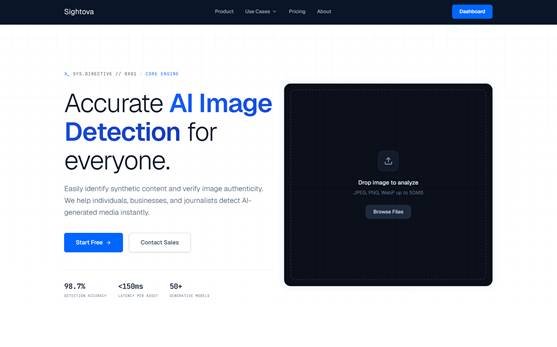
sightova.com flags AI-generated, tampered, NSFW, and violent imagery in milliseconds
The key shift is psychological. When people know that images can be assessed quickly and at scale, the screenshot loses some of its intimidation factor. The “proof” begins to look like what it is: a claim that needs checking.
What verification looks like, when it’s done properly
Verification is not one trick. It’s a set of habits, and it changes depending on who you are: an individual, a school administrator, a journalist, a platform moderator, or a corporate investigator.
Here are patterns that hold up in practice:
Ask for the original, not the crop
Screenshots are often tightly cropped to hide inconsistencies: missing status bars, mismatched fonts, odd spacing near timestamps. Asking for the full screen capture, including the top status area and the input field, can expose telltale artifacts.
If the sender refuses to share an uncropped version, that does not prove fabrication, but it should slow everything down.
Request a screen recording
A quick screen recording that scrolls through the conversation, shows the profile, and demonstrates navigation can be harder to fake convincingly (not impossible, but harder). It also forces the claimant to show more context, which is where fabrications tend to fray.
Cross-check the platform itself
Many people forget an obvious step: open the app and check. If you are accused of sending messages you didn’t send, pull up your conversation view. If you’re being pressured with a screenshot, ask for the username, the handle, the number, the exact account, then verify from your own device.
Scammers often rely on the victim not doing this because the victim is panicking or because the scammer has framed it as dangerous (“If you open it, it will alert the police,” “If you message me again, I’ll leak it”).
Treat “forwarded screenshots” as contaminated evidence
If the screenshot came through a chain of friends, it is already unreliable. Every forward strips context and increases the chance of motivated editing. In investigations, the chain of custody matters. In everyday life, the same logic applies.
Look for internal inconsistencies
People tend to focus on the explosive line. But fakes often contain small errors: a timestamp format that does not match the user’s locale, a battery icon style inconsistent with the device model, a profile photo that appears slightly misaligned, a font weight that looks off. None of these alone are definitive. Together, they can suggest fabrication.
Separate the accusation from the demand
In sextortion and some romance scams, the goal is not to prove anything. It’s to push payment. The moment money enters the conversation, treat everything as a sales pitch. “Pay now or else” is not how real institutions behave, and it’s not how most genuine interpersonal conflicts unfold either.
Who gets hit, and why “it won’t happen to me” is a weak strategy
The stereotype victim of fake chat coercion is someone naive or careless. That stereotype is convenient. It keeps the rest of us comfortable.
In reality, fake chat threats work because they exploit universal human vulnerabilities: fear of humiliation, fear of losing relationships, fear of being misunderstood. Professionals, parents, students, and retirees all have something to lose. A scammer only needs one pressure point that the victim cannot afford to gamble with.
It also works because people are busy. Verification takes time. The modern attention economy punishes slowness. Scammers build their scripts around that.
The bigger story: trust is becoming a technical problem
For decades, “trust” online was mainly about identity and intent. Is this person who they say they are? Are they trying to harm me? Now there’s a third axis: is this artifact real?
A chat screenshot is an artifact. So is a voice note. So is a selfie. As artifacts become easier to fabricate, institutions will be forced to decide how much weight they give them, and under what conditions.
That decision will shape everything from school discipline policies to HR investigations to harassment reporting systems. If the only accepted evidence is a screenshot, bad actors will bring screenshots. If stronger evidence is required, platforms and institutions will need to offer ways for victims to produce it without putting themselves at risk.
Where this leaves ordinary people
Most people do not have forensic tools. They should not need them to protect themselves from a JPEG.
But a few behavioral changes help:
- Slow down when presented with a screenshot that triggers panic.
- Move the conversation to a verifiable channel (in-app checks, direct calls).
- Talk to someone before paying, posting, or reacting publicly.
- Assume that “proof” can be manufactured, especially when it arrives alongside a demand.
The uncomfortable truth is that fake chats will keep getting easier to generate. The question is whether our reflexive trust in screenshots will keep pace. If we treat every chat image as a starting point for verification instead of an endpoint for belief, the economics of these scams change. Less panic means fewer payments. Fewer payouts means fewer people running the scam.
And that is how the threat landscape shrinks, not through a single magic fix, but through millions of small refusals to be rushed by a picture.